

In the process of applying dye to the sunflower, the expression of the sunflower is actually very layered:
In the process of applying dye to the sunflower, the expression of the sunflower is actually very layered:
Flower center: brings out a darker brown and grayish-black tone
After being mordanted with iron, the color will turn into a low-saturation olive green and grayish yellow.
But it's not the only thing that truly makes the color ticket complete.
I added two plants for comparison:
▍Seven Mile Fragrance
The leaves contain stable tannins
👉 The colors are mostly soft gray-green and light khaki.
👉 Under iron mordant dyeing, it becomes more subdued and has a misty feel.
▍Paper Tree
Thick leaves and strong fibers
The leaf veins are clear and the texture is well-defined.
The color ranges from yellowish-green to olive.
When the three plants are tested together, you'll see something very interesting:
Colors begin their "dialogue"
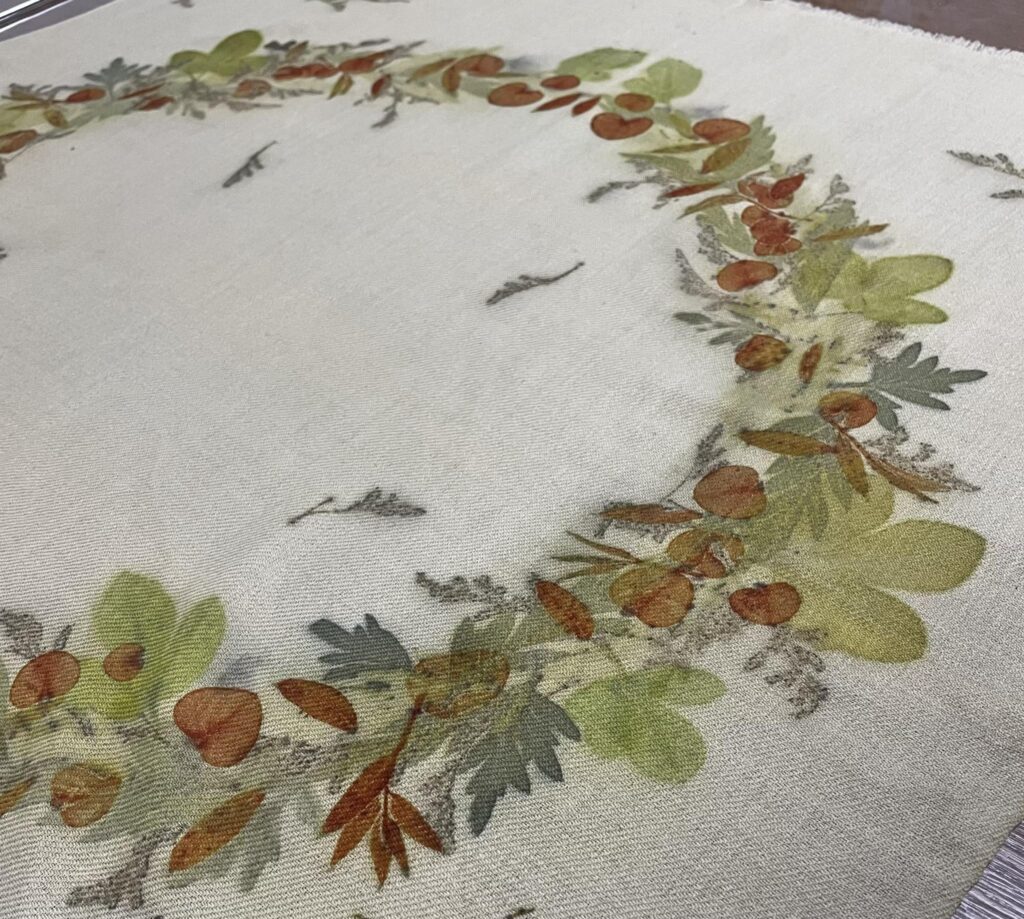
From the deep olive on the far left, to the misty gray-green in the middle, and then to the warm yellow on the right.
This is no longer the effect of a single plant, but a whole "natural gradient".
The distinctive feature of this set of color swatches is:
Lacking the sharpness of artificial pigments
Each piece of fabric has subtle differences.
The colors are in a "transition," not a "contrast."
This is the most fascinating aspect of plant dyeing.
It's not perfect, but it's very real.
In this test, mordant played a key role: Iron mordant (Fe) → suppressed the color, turning it into grayish-green or olive shades; Aluminum mordant (Al) → retained a brighter yellow and a clear feel; No mordant → the most natural color, but with lower stability. The same leaf, different mordants, creates different worlds.
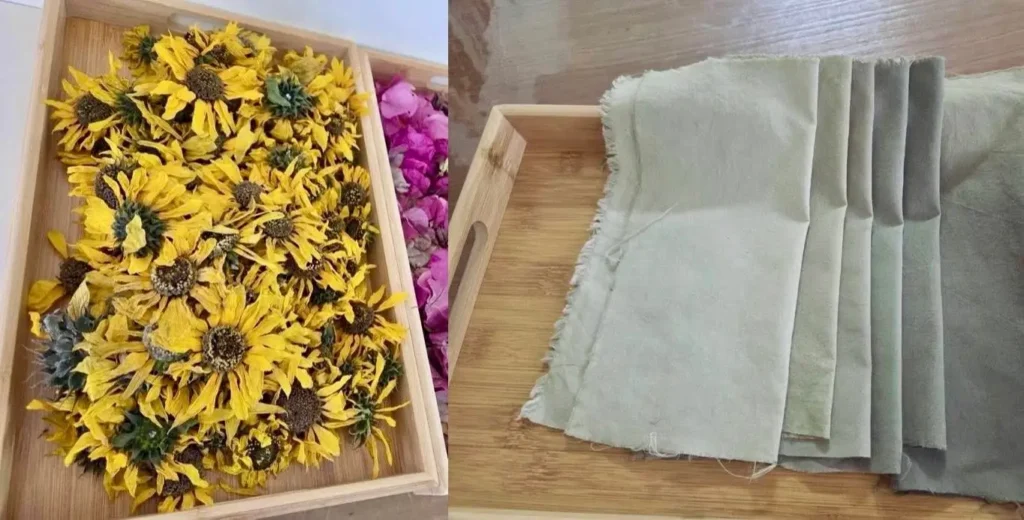
This set of color swatches isn’t just for research.
It can be directly applied to: Plant-dyed clothing design; Brand color system establishment; Course teaching (color observation and mordant differences); Exhibition websites (color swatch guide).
You’ll find that when you begin to grasp the concept of a “color system,” your work is no longer just a single piece, but a “series design.”
Many people ask, “Can this color be replicated?” The answer is: it can be close, but it won’t be the same. This is because there are too many influencing factors: Harvesting time (season, maturity) Leaf condition (fresh/dry) Fabric fibers Water quality and temperature Therefore, every piece of fabric is a “record of the present moment.”
Starting with a single sunflower, we don’t just gain a single color, but rather unlock an entire color system belonging to nature.
This isn’t about controlling color; it’s about understanding color.
This is also what I’m continuously working on: slowly transforming the forest into something wearable.